I had an amazing adventure in Madagascar, thanks to Pioneer Expeditions.
My interest lay not only with the lemurs, but very specifically with the Aye-Aye. I met Laurenne at the Destinations Travel Show in London some years ago and expressed this interest, and she instantly knew where I should go to see them with some certainty. Thus our discussions began, and ultimately she put together an itinerary based mostly on the 12-day "Southwest Treasures" package with additional days at the start to detour just a little further north, to Palmarium, resulting in a 15-day trip.
When I began my research, Pioneer Expeditions also offered a "photographic tour", also based on the 12-day "Southwest Treasures" package, and I advised Laurenne that photography was a particular interest for me. Unfortunately this specific tour is no longer available, but Laurenne liaised with her contacts in Madagascar and found that one of the guides in the company she uses also has a strong photography interest. Luckily, he remained available when my trip was finalized, and I found him to be an amazing guide as well as a great help with the photography.
My adventure was tailormade for me, this was not a group trip.
The highlight of the trip for me was definitely Palmarium, where I did indeed see the Aye-Aye. I am delighted that Laurenne could add this to my plans. I wasn't the only enthused person: there was a pair of retired American women who had endured a 32-hour flight to Madagascar specifically to do just the loop that included Palmarium. They agreed it was worth the effort!
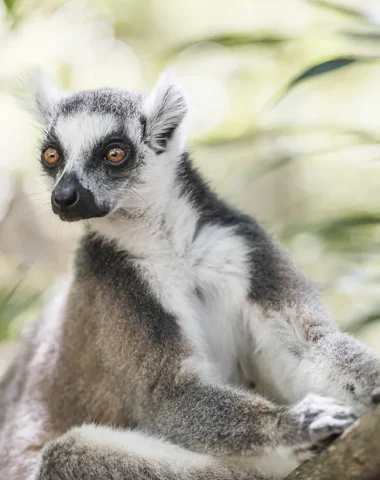
This "loop" includes the visit to Andasibe, which was my second-favorite park and encounter with lemurs and other wildlife. On the day of arrival, a nocturnal walk was planned - which started at about 6pm. This was fantastic, although we did encounter a bit of rain. We then returned for a morning visit, and this as my first encounter with the Indri in particular. It was amazing to be there when they began their unique call (which I managed to capture on video on my phone).
And my third-favorite park was Zombitse, although Anja came close.
The hotels were equally amazing. Most were not hotels in the way I think of them, as a single building, of multiple storeys, and in fact about half of them were termed "eco lodges" - but they were so well presented, they felt on the same class as a good hotel. In general, they comprised a reception/restaurant building, then a number of individual bungalows, a short walk from reception. My favorite was the Satrana Lodge, where we were based for the foray into Isalo National Park. The food at all the hotels we used was excellent. And for me, far too much, which was disappointing because I was worried about wasting food. Sometimes I was able to decline a course, and sometimes I was able to ask for a "half portion", with the help of my guide. It's worth noting that the hotels always asked for menu choices to be made earlier in the day (or upon arrival) and to choose the time to eat. My understanding is that they need this help for planning food and staff. Understandable, but I admit I found it tricky because of my general lack of appetite.
A note about the driving: you will notice some long drives in the itineraries. You probably know Madagascar is the 4th largest island in the world, and is about double the size of Great Britain. Therefore, if you compare, say driving from London to Scotland, you can understand some of the timings. What I had not anticipated was the state of their roads. Unfortunately, they suffer every year from the cyclones in the rainy season, and the country simply cannot keep up with the amount of repair needed. Some are so bad, it's like being out on one of those 4x4 "experiences" - it is therefore a good thing that the transport is in a good 4x4 with an experienced driver! Once or twice I found the longer journeys in these conditions to be very tiring - I cannot imagine what it was like for our driver. Thankfully, not all roads are so bad, and some are in excellent condition. But it does mean that some journeys take an awful lot longer than you might imagine.
Another thing I found helpful in advance was understanding tipping. Tipping is very much expected, and so I made sure to be fully prepared in advance. You will get porters at each hotel, and while on the first night I was thinking that I wasn't really going to need them (but I would accept them), once we started getting to the lodges I fully appreciated their assistance, given the distances and staircases involved (to reach the assigned bungalow). Additionally, at each park, the country rules are that local guides must be used - so my "tour guide" cannot conduct these tours. Although having been on them many times, he was knowledgeable! Thus, the local park guides should be tipped, too. What I hadn't expected was that the guides work hand-in-hand with an "animal spotter". Although then it made sense. The guide takes you along the appropriate paths and explains everything, while the spotters run ahead and check that the expected animals are where they are expected - specifically the families of lemurs, who will travel through the trees at will. They find the animals and run back to the guide, who then chooses the appropriate path, which may include retracing our steps for a bit. The spotters are also often in training to be the next generation of guides. I was advised that the spotters should also receive a tip, typically half what it was suggested that I give the local guide.
To conclude, and reiterate, this was a fantastic holiday adventure, very well planned and organized by Pioneer Expeditions.